RESEARCH 06
Quantum Computing
QUANTUM & AI
Fusing quantum computing with deep learning — leveraging superposition and entanglement to jointly optimize the features and model architecture of medical AI.
Fusing quantum computing with deep learning — leveraging superposition and entanglement to jointly optimize the features and model architecture of medical AI.
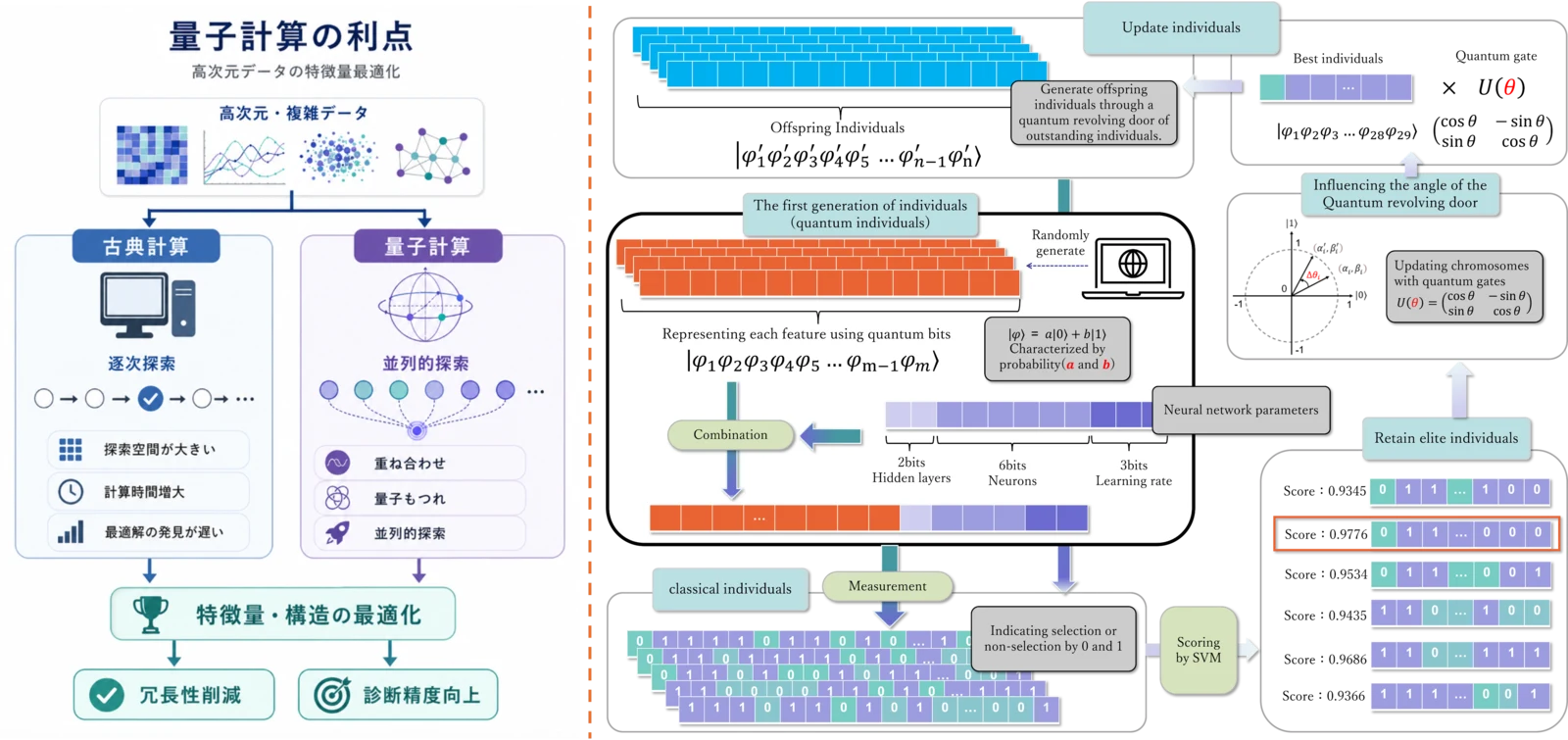
Quantum computing can potentially offer high parallel processing capability for certain computational problems by exploiting qubit properties such as superposition and entanglement. For complex, high-dimensional datasets in particular, fusing quantum computing with deep learning is expected to enable efficient selection of effective features and optimization of a deep learning model's network architecture parameters.
Using a quantum evolutionary algorithm, this research jointly optimizes feature selection and network architecture parameters for deep learning models that diagnose disease, applied to medical datasets on breast cancer, Parkinson's disease, and heart disease. We further validated the proposed method's feasibility through real hardware trials on a quantum computer.
Each feature is represented as a qubit |φ⟩ = a|0⟩ + b|1⟩, and superposition and entanglement allow the high-dimensional search space to be scanned in parallel. Measurement converts this into a 0/1 selection vector for evaluation, and iteratively updating elite individuals with a quantum rotation gate U(θ) converges on high-quality solutions in few generations.
Feature-selection bits and network architecture parameters — number of hidden layers, neurons, and learning rate — are integrated into a single chromosome and searched simultaneously. This finds better combinations, including the compatibility between the two, more efficiently than tuning features and model architecture separately.
Applied to models that determine the presence or absence of disease using medical datasets on breast cancer, Parkinson's disease, and heart disease, substantially reducing redundant features in the data while improving diagnostic accuracy.
Going beyond simulation, we validated the proposed method's feasibility through trials on real quantum computer hardware.