RESEARCH 05
IoT & Robotics
IoT / ROBOTICS
AI that flies through the sky and dives underwater — intelligence running on ultra-small devices, tackling challenges in the field.
AI that flies through the sky and dives underwater — intelligence running on ultra-small devices, tackling challenges in the field.
Edge devices such as drones, underwater robots, and small sensors have extremely limited computing resources, power, and weight, making it a major technical challenge to run advanced AI inference on them. Yet AI capable of autonomous, on-site decision-making meets a wide range of societal needs — disaster response, environmental surveying, smart agriculture, and infrastructure inspection.
We develop intelligent systems that complete their tasks on-site, without relying on the cloud, by fusing AI with IoT and robotics. Our work spans everything from lightweight model design through to integration on real hardware.
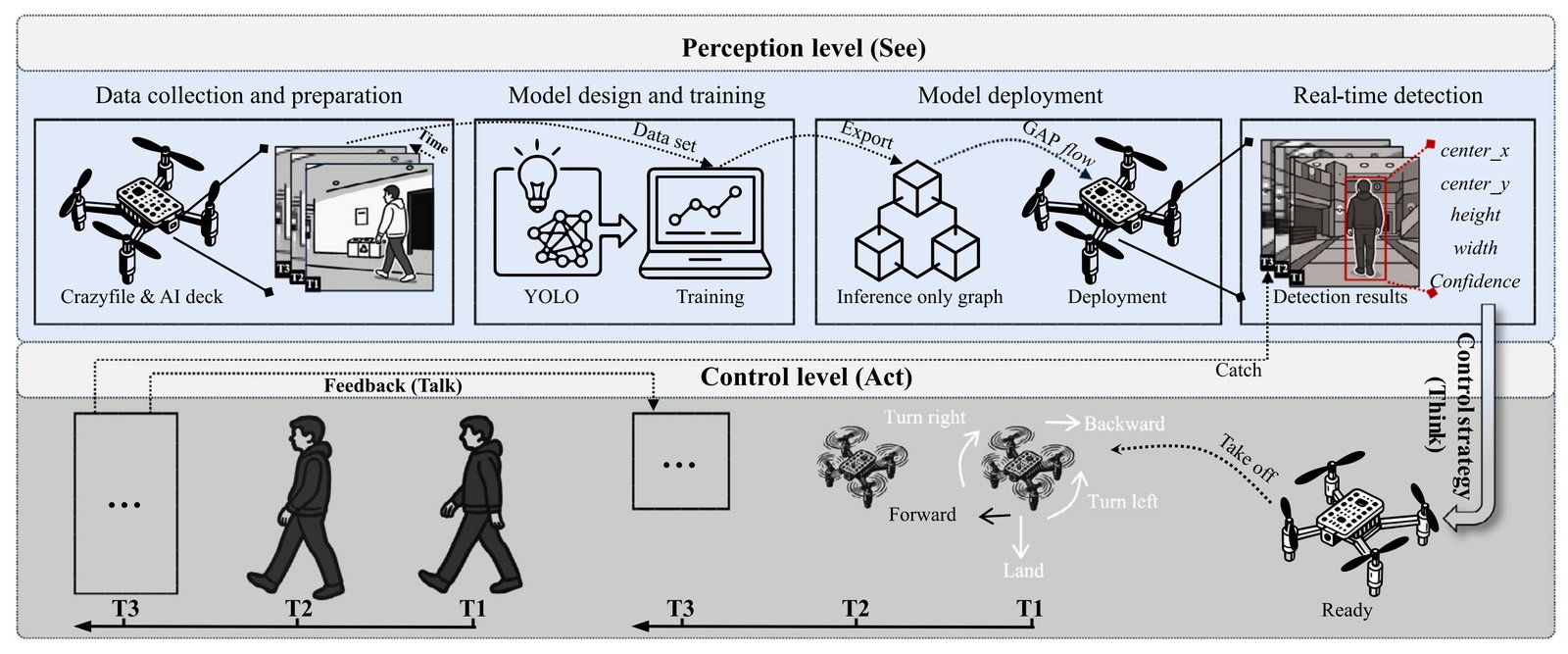
A nano UAV weighing just 29 g and drawing milliwatt-level power carries "FeatherYOLO," an ultra-lightweight detector with roughly 20,000 parameters. It achieves fully on-board object tracking and visual servoing at 150 FPS and 46.5 mW (published in EAAI).
Building a smart monitoring platform that fuses deep learning with digital twins to grasp the state of plants and equipment remotely and in real time.
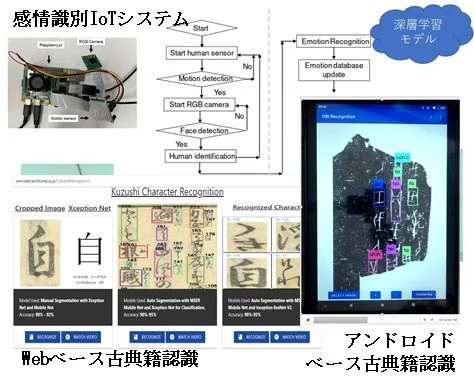
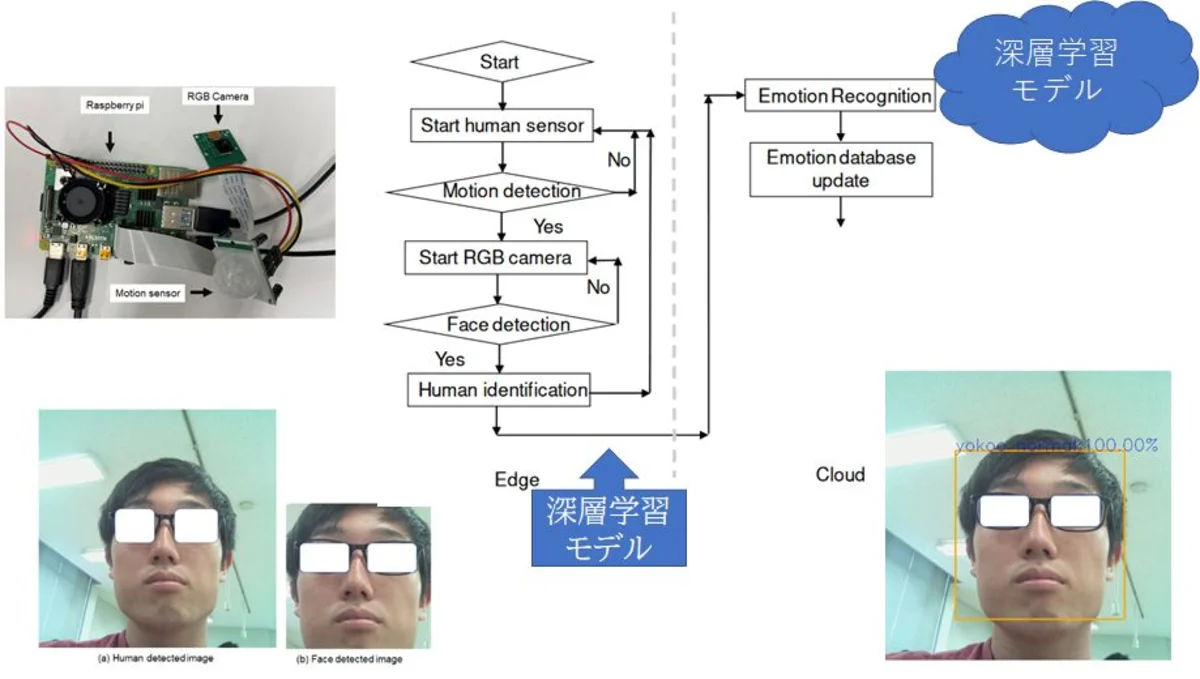
With overwork on the rise, managing modern people's health — especially fatigue and mental health — has become increasingly important. A motion sensor on the edge side detects a person, extracts and identifies their face, and transfers the facial image to a server, where deep learning identifies emotion. By quantitatively evaluating accumulated changes in expression, we aim to detect fatigue and mental strain at an early stage.
Integrating detection models and depth cameras into embedded devices such as Jetson Nano, deployed in practical systems including mask-wearing and social-distance monitoring and dish-collecting robots.
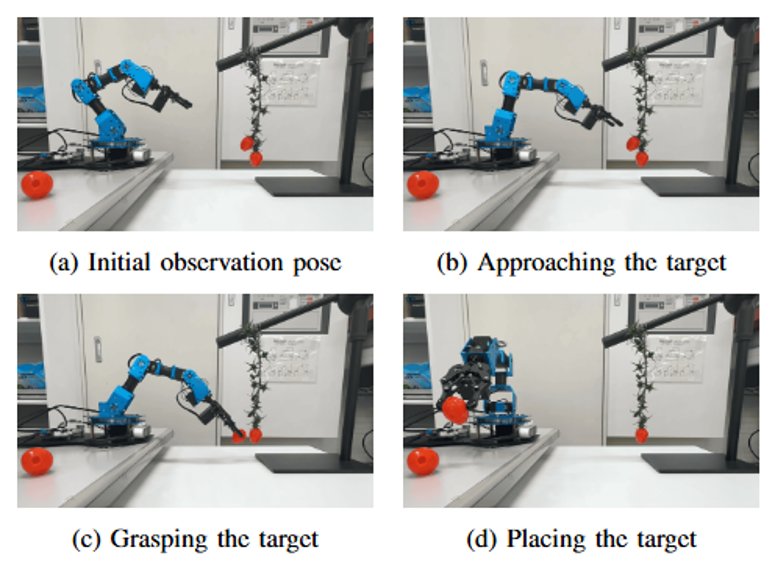
Targeting complex environments with dense fruit clusters, occlusion, and foliage interference, we research an automated cherry tomato harvesting system combining RGB-D vision with intelligent robotic manipulation. AI-based visual recognition and 3D localization capture the fruit's spatial information, and we assess harvestability and determine harvest order based on the degree of occlusion, reachability, and grasping risk. Combined with the robotic arm's motion planning, active viewpoint adjustment, and dual-arm coordination, the system advances from merely "seeing the fruit" to "judging and stably harvesting the fruit."